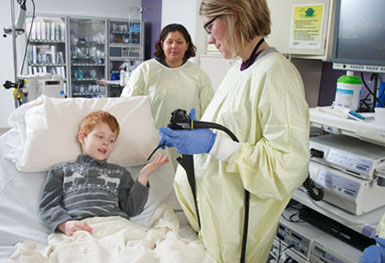
What I value most about my fellowship training here is the availability of resources — both clinical and research — and the commitment of faculty who are deeply invested in our success. Training at a free-standing children's hospital provides exposure to a high volume and breadth of pediatric GI pathology, along with a collaborative, child-focused environment. It has been an ideal setting to grow as a clinician and as an academic pediatric gastroenterologist.
Our division actively publishes in basic, translational and clinical research realms. All fellows in our program are required to complete two years of research.
Research Opportunities
The Division of Pediatric Gastroenterology, Hepatology, Pancreatology and Nutrition at the University of Iowa offers fellows a broad range of research opportunities spanning basic science, translational, and clinical research. All fellows complete two years of dedicated research training, working closely with faculty mentors to develop research skills, pursue individual interests, and build a foundation for a career in academic medicine or clinical practice.
Fellows may pursue research within our division or collaborate with investigators across the University of Iowa. Opportunities include laboratory-based studies, translational research using animal models and human biospecimens, clinical and epidemiologic studies, and multicenter collaborative research.
Research within our division encompasses several areas of pediatric gastroenterology, hepatology, pancreatology, and nutrition. Dr. Aliye Uc leads research focused on the mechanisms and progression of pancreatic disease in cystic fibrosis, using translational animal models, and the genetic, clinical, and biological factors contributing to acute recurrent and chronic pancreatitis in children. She co-leads the NIH-funded INSPPIRE research program, a multicenter collaborative study investigating the causes, progression, and outcomes of pediatric pancreatitis. Her research also includes studies of pancreatic complications in cystic fibrosis and other translational approaches to understanding pancreatic disease.
Dr. Aamer Imdad is Assistant Professor of Pediatrics | Associate Program Director, Pediatric Gastroenterology Fellowship, and physician-scientist whose research focuses on early-life nutrition, infant feeding, childhood growth, and the prevention and management of childhood obesity. His research integrates clinical epidemiology, large-scale electronic health record data, machine learning, evidence synthesis, and implementation science to improve child health outcomes.
A major focus of his research is understanding how early-life nutritional exposures, particularly infant formula composition and feeding practices, influence childhood growth, and obesity risk. His team is also developing machine learning models using data from the first 1,000 days of life to predict childhood obesity and identify opportunities for early intervention. In addition, he is involved in developing and evaluating multidisciplinary approaches to childhood obesity management, including the integration of digital health technologies and evidence-based interventions into clinical care.
Another area of research focuses on improving oral feeding outcomes in premature infants in the neonatal intensive care unit (NICU). Through multidisciplinary collaborations, his team is investigating predictors of feeding difficulties, developing standardized feeding protocols, and implementing quality improvement initiatives to improve feeding outcomes.
Dr. Imdad has extensive expertise in systematic reviews, meta-analysis, and evidence-based clinical practice guideline development. He has contributed to guidelines for the World Health Organization (WHO), American Gastroenterological Association (AGA), and North American Society for Pediatric Gastroenterology, Hepatology and Nutrition (NASPGHAN).
His research also includes pediatric gastrointestinal disorders, particularly nutrition-related conditions, constipation, and feeding difficulties.
He has authored or co-authored approximately 100 peer-reviewed publications and actively mentors medical students, residents, and fellows. Research opportunities for pediatric gastroenterology fellows include childhood obesity research, clinical outcomes studies, retrospective and prospective cohort studies, systematic reviews and meta-analyses, clinical practice guideline development, quality improvement, and implementation science.
Dr. Dawn Ebach is involved in inflammatory bowel clinical research. Dr. Toshifumi Yodoshi is a pediatric gastroenterologist, hepatologist, and clinical epidemiologist with a PhD in Epidemiology. His research focuses on pediatric metabolic dysfunction-associated steatotic liver disease (MASLD), obesity, clinical nutrition, and pediatric liver transplantation. His work combines clinical epidemiology, large-scale healthcare databases, and prospective clinical studies to investigate disease progression, treatment effectiveness, and long-term patient outcomes. His current research interests include the effects of GLP-1 receptor agonist therapies on body composition, muscle mass, and bone health in adolescents with obesity; noninvasive assessment of liver fibrosis; and comparative effectiveness of obesity treatments. He also conducts research on pediatric liver transplantation, focusing on long-term outcomes, organ allocation policies, and disparities in access to transplantation. Through these efforts, he aims to generate evidence that improves clinical decision-making and long-term health outcomes for children with liver disease and obesity.
Fellows are also encouraged to pursue research with mentors outside the division. Previous fellows have collaborated with investigators in Pediatric Critical Care, Neonatology, Immunology, Internal Medicine, Gastroenterology, Hematology, and other departments and research programs across the University of Iowa. These opportunities allow fellows to tailor their research experience to their interests and career goals while developing skills in study design, data analysis, scientific writing, and presentation of research findings.